

More Than Music: How Kindermusik Helps Young Children Learn and Grow
What if 45 minutes of Kindermusik® each week could help build skills your baby, toddler, or preschooler will use for years to come?
Research shows it can!

Picture two children working on a puzzle in their classroom. One child tries a few pieces but can’t find any that fit. The child becomes frustrated and walks away to play somewhere else.
The other child tries several pieces without success, then gets advice from a friend to look for pieces with blue on them. They adjust their plan, and eventually get a few pieces to fit together as they work together.
The second child is showing flexible learning in action.
Flexible learners aren't children who always get things right or do things perfectly. They're children who are developing the perseverance, self-control, creativity, confidence, and adaptability to keep learning even when things don't go as expected.
And these skills don't suddenly appear when children enter school.
They begin developing long before that, through everyday experiences of movement, play, connection, and exploration.
That's where Tuneful Journey comes in!
Little Musical Moments. Big Developmental Growth.
Kindermusik Helps Young Children Learn and Grow at Each Stage
Kindermusik’s Empower Your Child With Music brochure highlights research on children participating in Kindermusik programs, showing meaningful developmental benefits—even with as little as 30 minutes of Kindermusik each week.
80% of children studied demonstrated a new ability to take turns.
76% of children who had not previously demonstrated self-control began to show it.
32% greater literacy gains were measured among children participating in the Kindermusik curriculum compared with children who did not receive it.
Children participating in Kindermusik were 2–3 times as likely to show significant improvement in Bead Memory, a measure of cognitive development.
These findings offer a glimpse into how intentional music-based learning can support skills that reach far beyond music.
So how does shaking an instrument, pretending to be an animal, or dancing to a song help build flexible learning skills?
It starts with meeting children right where they are developmentally.
Babies: First, I Discover Myself.
Birth–12 months | Foundations
Before babies can explore the world independently, they begin by discovering their own bodies.
Through rocking, bouncing, reaching, and responding to familiar songs, babies develop body awareness, sensory connections, and the beginnings of communication.
What it looks like: A baby reaching for a scarf while a caregiver holds it and moves it above and over them.
What they're building: Body awareness, early communication, and trust and connection with a caregiver.
The future connection: A child who feels safe, connected, and confident exploring their world has an important foundation for future learning.
1-Year-Olds: I Discover What I Can Do!
Ages 1–2 | Level 1
One-year-olds are on the move! They're discovering how their bodies move through space and how they can interact with objects.
Shaking, tapping, pushing, pulling, and carrying instruments are opportunities to explore cause and effect, coordination, and independence.
What it looks like: A toddler shakes an instrument, stops to listen, and shakes it again to hear what happens.
What they're building: Motor coordination, problem-solving, and early self-control.
The future connection: A child who experiments with cause and effect is learning that their actions can change an outcome—the beginning of intentional problem-solving!
Toddlers: I Can Move With Purpose and Imagine New Possibilities!
Ages 2–3.5 | Level 2
Two-year-olds are refining their movements while entering the exciting world of symbolic play.
A scarf becomes leaves blowing in the wind. A hoop becomes a mud puddle. A musical story becomes an adventure!
What it looks like: A child pretending to make pizza with rhythm sticks. They roll the dough, they shake the toppings on, and they make the timer click sound as they wait for it to cook.
What they're building: Motor planning, symbolic thinking, language, and imagination.
The future connection: A child who can imagine that one thing represents another is developing flexible thinking and symbolic understanding—important foundations for language, later abstract thinking, and creative problem-solving.
Preschoolers: I Can Connect My Ideas With Others!
Ages 3.5–5 | Level 3
Preschoolers are learning that their actions and ideas are part of a bigger social world.
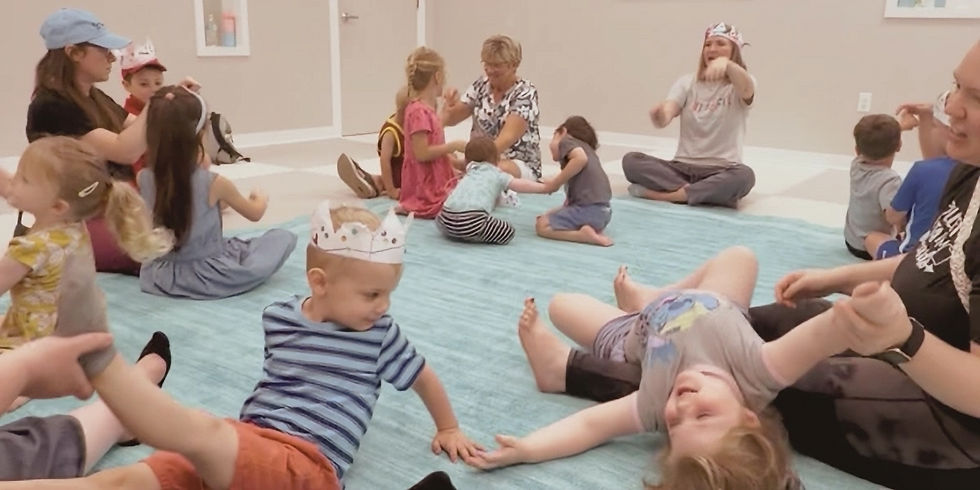
Musical games offer opportunities to practice waiting, listening, sharing, and participating with others.
What it looks like: Children taking turns playing a gathering drum, even when waiting feels hard.
What they're building: Impulse control, social awareness, cooperation, and emotional regulation.
The future connection: A child who practices waiting, listening, and participating with others is developing skills that help them build relationships.
Early School Agers: I Can Plan, Remember, and Adapt!
Ages 4.5–6 | Level 4
School agers are becoming increasingly capable of planning their movements, remembering sequences, and adjusting when something changes.
Musical patterns and movement games give children playful opportunities to exercise these growing abilities.
What it looks like: Children matching movements to different drum cues (quarter notes, eighth notes, half notes) and changing their movements based on the drum cues they hear.
What they're building: Working memory, motor planning, self-control, and cognitive flexibility.
The future connection: A child who can remember a plan, recognize a change, and adjust their response is practicing the flexible thinking needed for new challenges.
The Bigger Picture: Building Skills for Life
When we look at these developmental stages together, something wonderful becomes clear.
The baby discovering how their body moves is beginning a journey that leads to the one-year-old exploring cause and effect, the two-year-old imagining new possibilities, the three-year-old connecting with others, and the older child planning, adapting, and collaborating.
Each stage builds on the skills developed before it. That's the true magic of how Kindermusik® helps young children learn and grow.
At Tuneful Journey, we aren't rushing children to reach the next milestone. We're giving them experiences that support the skills they're ready to develop TODAY—because those skills become the building blocks for tomorrow.
Ready to experience Kindermusik® for your child? We'd love to welcome your family to a preview class at Tuneful Journey!

Tuneful Journey, Owner & Educator
(515) 451-7787